
How a massive edtech found clarity, autonomy, and speed in its product decisions
Imagine a huge, active city that never stops growing. Its streets work, but they were built at different times, by different teams, with signs that don’t follow a single standard. People reach their destination, but always with an extra detour. And the city hall spends more time putting out fires than planning or building. That city was Gran Cursos.
Present across Brazil and supporting students preparing for public exams, professional certifications, degrees, MBAs, and postgraduate programs, Gran Cursos always lived surrounded by data. They measured transactions, revenue, satisfaction, behavior. They listened to students. They collected information from everywhere. The information existed.
The problem was that there was no single map of the city.
Simple questions required long journeys.
Who clicked on something?
Who adopted a new feature?
Where does the student drop off?
The answers were out there, but scattered across different neighborhoods: Google Analytics, development tickets, spreadsheets, manual queries, qualitative inputs. Each team held a piece of the city, but no one saw the whole.
As the city grew, the disorder became obvious. Streets with different names. Conflicting signs. Duplicate constructions. A city hall eager to move forward but losing time just trying to understand its own territory.
It reached a point where painting new lines on old asphalt was no longer enough. They needed to rebuild the map.
The turning point: the search for a new kind of urban planning
Gran Cursos decided to look for more than a tool. They needed a data urbanization system. A platform able to organize the chaos, give teams autonomy, and build a culture where decisions were grounded in evidence, not in dependency. The evaluation was rigorous. It involved Product, Technology, Data, and Compliance. This was not a superficial choice. And that’s when a key difference emerged: the role of Minders.
“Anyone can learn a tool. What made the difference was Minders after implementation. Their partnership, support, the ongoing training… that is the real value.”
Choosing Amplitude came with a process. And that process unlocked something deeper: a new way for Gran Cursos to make decisions.

A digital transformation driven by data
The work begins: reorganizing to grow
Implementation didn’t start with events or SDKs. It started with questions. With understanding which paths the city truly needed to signal.
What did the team want to answer?
What decisions needed to be made daily?
Which events actually mattered?
How could the product learn to measure its own impact?
With that foundation, a clear taxonomy, shared governance, and a step-by-step validation process emerged. In just two weeks, they saw the first sign they were on the right track: they discovered that a feature they were about to decommission was, in fact, one of the most pedagogically valuable. The right information, in the right place, changed the fate of that “neighborhood.”
From there, the culture began to shift. Product meetings started with an Analytic Session: twenty minutes of simple, direct, easy-to-understand analysis. If a chart took more than five seconds to interpret, it was wrong. Simplicity became both rule and value.
The city finally had clear signs.
Autonomy enters the scene
Teams stopped waiting for reports and ticket responses. Now they walked the city on their own: crossing data, identifying bugs, measuring adoption, tracking impact, prioritizing improvements, monitoring releases with feature flags, and spotting frictions that once went unnoticed. Analysis stopped being a bottleneck. It became part of everyday work.
Then came MAIA
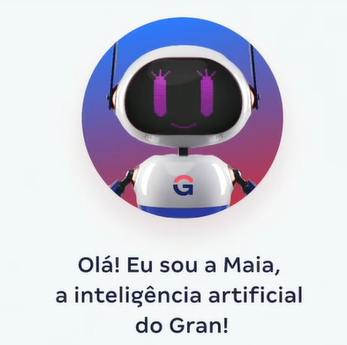
While reorganizing their streets, Gran Cursos was building something big: MAIA, their generative AI concept. The idea was simple and powerful: everything involving AI would have a consistent identity, a “face” that would accompany the student across the platform.
MAIA first appeared inside Gran Cursos Questões, generating explanations for answers. Then it expanded into a platform-wide chat designed to help students ask questions, receive suggestions, and navigate their learning journey.
But AI reshapes any city. And it brought new questions:
–> Was it truly helping students learn?
–> Where did it add value? Where did it fail?
–> Was it a retention tool, an adoption driver, or a support mechanism?
To answer that, they needed context, not loose numbers.
Today, with Amplitude, Gran Cursos sees every interaction with MAIA: questions sent, responses generated, student ratings, the path leading to the chat, and even unexpected behaviors, like students using MAIA as a traditional support channel.
This level of clarity made something essential possible: evolving an AI product in real time. They refined models, improved prompts, identified learning patterns, and combined AI with human review from their quality team.
“This feature was born already with metrics, clarity, and autonomy.”
What remains after a transformation like this
Gran Cursos’ story isn’t just about analytics — it’s about maturity. Previously, analyses were slow, data was scattered, decisions depended heavily on technical teams, and choices were often based on partial information. Now, teams are autonomous, dashboards are crystal-clear, conversations are grounded in evidence, the product evolves continuously, AI impact is fully monitored, and the culture understands that measuring is part of creating.
Gran Cursos didn’t just adopt a tool. It redesigned the way it builds.
Want to transform your data culture like Gran Cursos?
At Minders, we help companies across Latin America turn data chaos into intelligent, scalable, actionable decisions. If you want to build evidence-driven products, strengthen your analytical culture, or implement Amplitude with an expert partner, we’re here to help.
Let’s talk.
We’ll show you what this journey could look like inside your organization.