 Written by Josue Salamanca (Solutions Architect)
Why Customer Engagement Automation Fails—and How to Fix It
Most companies invest heavily in customer engagement automation technology, yet few achieve consistent and scalable results. At Minders, even while partnering with Braze—one of the most advanced customer engagement automation platforms on the market—we consistently see that the issue is rarely the tool itself. The real gap is the absence of a clear operating model that turns ideas into disciplined execution.
Our experience shows that without structure, automation efforts remain fragmented, slow, and dependent on individual contributors rather than organizational capability.
When organizations adopt a systematic approach, the impact changes dramatically: execution accelerates, quality becomes repeatable, and teams gain the confidence and clarity required to innovate at scale.
A successful customer engagement automation program is built on five foundational pillars:
-
A clear engagement lifecycle that functions as the operating system for how work moves from idea to launch.
-
An organizational structure that combines enablement teams with deep martech expertise.
-
A governance model that ensures quality, consistency, and compliance across every initiative.
-
A decentralized innovation approach that empowers teams while maintaining strategic alignment.
-
A measurement discipline focused on outcomes, not just activity.
Taken together, these pillars create a repeatable system—one that turns customer engagement automation from isolated campaigns into a strategic, scalable capability that compounds value over time.
Pillar 1 — A Clear Lifecycle: The Operating System of Customer Engagement Automation
Scaling customer engagement automation in Braze requires more than creativity or platform skills—it requires a clear, shared lifecycle that defines how work moves from idea to impact. A lifecycle is not bureaucracy; it is the operating rhythm that ensures consistency, quality, and speed across the entire automation program.
Below is the five-step lifecycle we recommend. It is intentionally simple, grounded in real Braze implementations, and built to minimize ambiguity while increasing accountability.
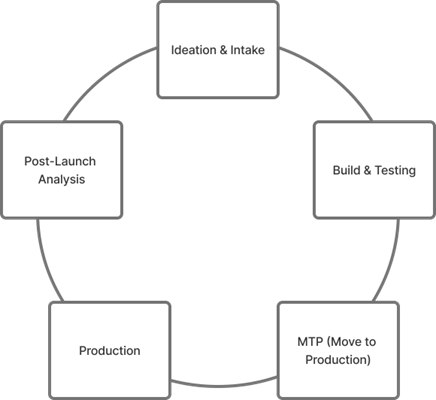
1.1 Ideation & Intake — A Structured Way to Capture Good Ideas
Ideation should happen through a central intake mechanism, for example, an internal portal where contributors submit structured automation requests.
This ensures ideas arrive “project-ready,” reducing back-and-forth and accelerating execution. They can also be prioritized based on impact and feasibility in an approval process.
1.2 Build & Testing — A Safe Environment to Create and Validate Journeys
Once an idea is approved, teams need a controlled space to build without risk. This requires a dedicated Braze development environment where contributors can create Canvas flows, test logic, trigger events, and simulate journeys without touching real users.
Examples include:
-
Test users and synthetic events to validate logic
-
The ability to QA personalization, segmentation, and branching
1.3 MTP (Move to Production) — Governance and Platform Protection
No one outside the automation center of excellence should have production access in Braze. For this reason, MTP is a formal gateway that ensures automations meet quality, compliance, and platform standards before going live.
An effective MTP process includes:
-
Production-team review
-
Confirmation that the Canvas doesn’t conflict with existing journeys
-
Scheduling, throttling, and frequency-capping alignment
This protects customers, protects the brand, and protects the platform.
1.4 Production — Live Impact with Real Users
Once approved, the automation is deployed into the live Braze environment. At this stage, the focus shifts to stability and controlled rollout. This phase confirms the automation is behaving as intended at scale.
1.5 Post-Launch Analysis — Closing the Loop
Automations in Braze rarely remain active forever. Journeys evolve, customer behavior changes, and business priorities shift. Post-launch analysis determines whether the automation still drives value.
This includes:
-
Evaluating impact against the KPIs defined at intake
-
Identifying drop-offs within the journey
-
Deciding whether to iterate, scale, or deprecate the automation
This step ensures the lifecycle is continuous—not a one-way flow.
Why This Lifecycle Works
This structured model balances clarity with flexibility. It reduces ambiguity, accelerates execution, enforces platform governance, and ensures Braze remains a scalable customer engagement automation engine rather than a collection of disconnected Canvas flows. Most importantly, it prepares the organization for decentralization—because teams can only innovate safely when everyone shares the same execution blueprint.
Pillar 2 — The Teams Behind Scalable Customer Engagement Automation
Even the best lifecycle fails without the right teams supporting it. In customer engagement automation programs—especially those built on Braze—the most effective operating model relies on two clearly differentiated groups: the Enablement Team and the Expert Team. Each plays a distinct role in helping the organization scale automation safely, efficiently, and with growing autonomy.
2.1 The Enablement Team — Empowering Citizen Developers
The Enablement Team focuses on expanding the program’s reach across the organization. Their mission is not to build automations or solve technical challenges, but to help people participate effectively in the lifecycle without requiring deep platform expertise.
Their responsibilities include:
-
Promoting adoption: helping teams discover opportunities and bring ideas forward
-
Reviewing intake: helping refine objectives, audiences, and KPIs
-
Supporting non-technical contributors: guiding early-stage ideas
-
Pointing contributors to training: Braze Academy and internal resources
This team accelerates participation and empowers more citizen developers, reducing bottlenecks and increasing throughput.
2.2 The Expert Team — Safeguarding the Platform
While the Enablement Team expands adoption, the Expert Team ensures everything built in Braze is technically sound, compliant, and aligned with best practices. They are the platform stewards—the group responsible for complexity management and quality control.
Their responsibilities include:
-
Solving complex challenges: advanced segmentation, multi-step logic, cross-channel experiences
-
Running MTP reviews: data checks, naming conventions, architecture validation
Citizen developers work independently as much as possible—but when they hit a technical wall or need to go live, the Expert Team is the escalation point.
This dual-team model drives autonomy without compromising control.
Pillar 3 — Governance: Policies, Training, and Quality Gates
As more teams begin building automations in Braze, governance ensures that customer engagement automation remains consistent, predictable, and scalable. Governance is not about control—it’s about enabling safe innovation through clarity and structure.
To implement governance effectively, organizations should focus on:
Design Standards
-
Standardized naming, documentation, and architecture
-
Alignment with brand and data strategy
Quality Gates
-
MTP reviews as mandatory checkpoints
-
Validation of events, segmentation, and personalization before going live
Platform Hygiene
-
Archiving deprecated Canvases
-
Removing duplicates and cleaning old templates
-
Reviewing segments and event usage quarterly
Well-executed governance reduces ambiguity, improves reliability, and increases speed—all essential for scaling customer engagement automation confidently.
Pillar 4 — Empowering Decentralized Customer Engagement Automation
As the automation program matures, organizations can decentralize execution. Decentralized innovation allows more people to contribute to customer engagement automation safely, without compromising platform integrity.
Three Enablers of Controlled Decentralization:
-
Training: A structured learning path using Braze Academy and internal guides
-
Controlled Autonomy: Dev access for ideation and testing; production access only via Expert Team
-
Continuous Onboarding: Support for new contributors through intake coaching and lifecycle alignment
This model increases capacity without overloading experts, builds organizational resilience, and creates a shared culture of experimentation.
Pillar 5 — Measuring What Matters in Customer Engagement Automation
As automation scales, measurement connects execution to business outcomes. The goal is not to track activity—but to understand whether customer engagement automation drives real impact.
Key Questions for Measuring Program Impact:
-
How is automation contributing to revenue, retention, or LTV?
-
What % of customer interactions are automated?
-
What incremental value is being created across the year?
-
How fast can we go from idea to launch?
-
How many teams are actively contributing?
-
What operational savings have been realized?
These questions assess the success of the automation program—not just individual journeys—by focusing on outcomes and capability growth.
Conclusion: Turning Customer Engagement Automation into a Competitive Advantage
The organizations that win in customer engagement automation are not the ones with the most sophisticated tools—they are the ones that operationalize them effectively.
By establishing a clear lifecycle, empowering contributors, enforcing guardrails, scaling participation, and measuring real outcomes, companies turn automation into a strategic advantage that compounds over time.
The playbook is simple. The discipline to execute it is what sets leaders apart.