How Amplitude’s AI Analytics Platform Speeds Up Insight and Action
A few years ago, shipping fast was impressive. Today, it’s the baseline. Teams deploy daily, campaigns launch in hours, and experiments pile up faster than most organizations can interpret them. AI didn’t just accelerate this—it changed the shape of work. Now it’s easy to generate ten versions of a flow, a landing page, or a message. The bottleneck isn’t creation anymore.
It’s understanding.
And when understanding lags behind shipping, speed stops being an advantage. It becomes a risk multiplier. You’re not just moving quickly—you’re moving quickly on assumptions that may already be outdated.
That’s the backdrop for why Amplitude is upgrading its AI Analytics Platform with something bigger than “AI insights.” The goal isn’t to make analytics prettier or faster to query. It’s to make analytics operate at the same tempo as modern product teams: continuously sensing what’s happening, connecting context across the customer journey, and helping teams act—not weeks later, but while the work is still in motion.
The real problem isn’t dashboards. It’s the handoffs.
Most analytics breakdowns don’t come from a lack of data. They come from a workflow that can’t survive modern velocity.
A metric dips. Someone notices (eventually). A thread starts. A ticket gets filed. A dashboard is built. A meeting is scheduled. Then comes the debate: is this real, is it tracking, is it seasonality, is it a segment shift, is it an experiment, is it a release?
Meanwhile, the team ships three more changes.
That workflow made sense when releases were monthly and experimentation was occasional. In an AI-speed world, it collapses—because it relies on humans to notice, assemble context, and drive the investigation every time. Analytics becomes a reporting function, and reporting is always late.
Amplitude’s bet is that analytics can’t just report anymore. It has to reason.
What AI-scale analytics actually means
“AI analytics” has become a crowded phrase. Plenty of tools can summarize charts or answer questions in plain language. Useful, sure—but still reactive. They respond when you ask. They don’t make sure the right questions get asked in the first place, and they don’t reliably connect the dots across the full behavioral picture.
AI-scale analytics is different. It’s built around continuous investigation:
- noticing meaningful change across the journey,
- understanding who it affects and where it shows up,
- connecting signals across data, experience, and feedback,
- and pushing toward a decision: what do we do next?
That’s the shift Amplitude is making with Amplitude Agents—an agentic layer inside the AI Analytics Platform designed to keep understanding moving at the pace your team is building.
The heart of it: a Global Agent that investigates like a strong team would
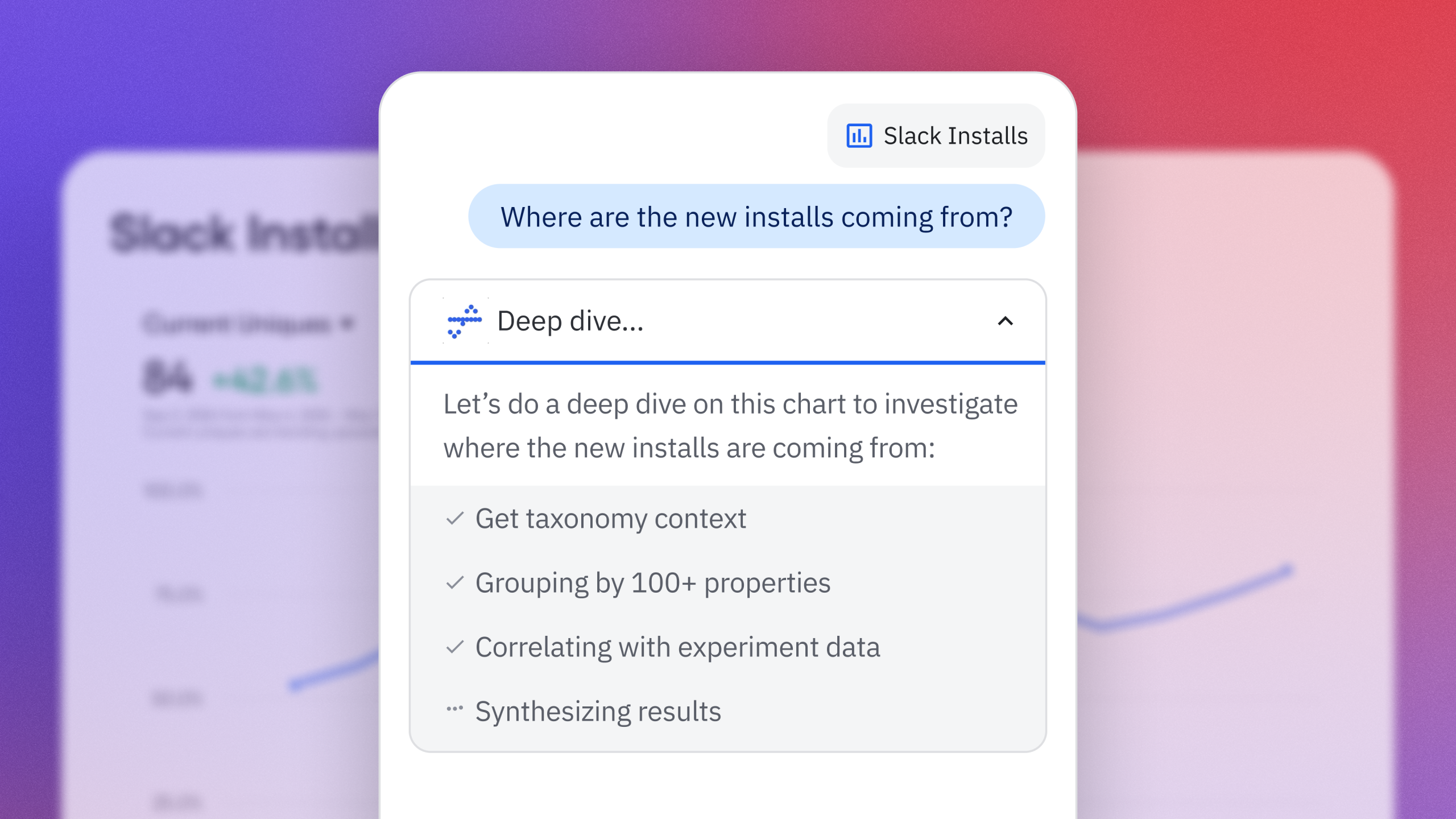
At the center is what Amplitude calls the Global Agent. Think of it less like a chatbot and more like an investigator that can traverse the entire Amplitude ecosystem: behavior, journeys, experiments, session replay evidence, and feedback. The important part isn’t that it can “answer questions.” It’s that it can run the whole investigation you’d normally coordinate across multiple people and tools.
So when someone asks, “Why did activation drop last week?” you don’t get a single chart and a shrug. You get an analysis that tries to earn your trust: what changed, where it changed, which cohorts moved, whether experiments or releases overlap, whether instrumentation looks suspicious, and what the most plausible drivers are.
It also incorporates team context—what you’ve been looking at lately, which metrics are in focus, and what priorities have shifted—so it’s not generating generic observations. It’s trying to surface what matters to your team right now. And because it’s conversational, it doesn’t dead-end after one answer. It pulls you through follow-ups the way a great analyst would: “Do you want to break this down by channel?” “Should we compare new vs returning?” “Did anything ship in this flow last week?”
The punchline here is time compression. Root cause work that often takes days of back-and-forth can happen in minutes, because the system can scan broadly and connect evidence fast. And it’s built to meet teams where they already collaborate, not just inside an analytics tab—so it can show up in tools like Slack or Teams when the question is being asked.
The second half: Specialized Agents that prevent “we missed it”
Even with a powerful investigator, teams still miss things—not because they’re careless, but because no one can watch everything all the time.
That’s what Specialized Agents are for. Instead of waiting for a human to notice a problem and start the process, these agents run on a schedule and proactively surface what’s happening. Each one is focused on a single workflow, which matters because focus is what turns “AI” into something operational.
Amplitude’s current set maps to the pain points most teams feel every week:
A monitoring agent for dashboards, so trends and anomalies don’t sit quietly until they become a fire drill.
A session replay agent, so qualitative friction isn’t buried under a mountain of videos no one has time to watch.
A web conversion agent, oriented around experimentation—proposing tests, generating variants, and helping structure launches and results.
A feedback agent, which turns messy, unstructured feedback into themes you can actually use, before it becomes “we should read the tickets” guilt.
This is how analytics stops being something you visit and becomes something that keeps watch. Not to replace analysts, but to remove the bottleneck where every investigation depends on one person’s bandwidth.
The third shift: put behavioral intelligence inside the tools where decisions happen
Even if insights are strong, there’s another silent failure mode: insight arrives too late because it lives in the wrong place.
Teams don’t make decisions inside analytics platforms. PMs make decisions in planning docs. Designers make decisions in Figma. Engineers make decisions in PRs and IDEs. Growth teams make decisions in campaign builders. When analytics is a separate destination, it becomes optional—and optional gets skipped at high speed.
This is where Amplitude’s Model Context Protocol (MCP) server comes in. The idea is simple: bring Amplitude’s behavioral intelligence into the AI workflows your team already uses, so questions, investigations, and actions can happen without switching contexts.
That can look like a PM asking an assistant (Claude/ChatGPT) to pull behavioral context for a roadmap decision. It can look like an engineer validating impact directly inside a development environment like Cursor, or attaching usage context to a GitHub pull request. It can look like designers sanity-checking prototypes with real behavior signals, or sales and engagement workflows using behavioral signals to personalize outreach.
In practice, this matters because it shrinks the distance between building and learning. Insight shows up at the moment of decision—not in a post-mortem.
One system, not a pile of features
It’s tempting to see “Global Agent,” “Specialized Agents,” and “MCP” as three separate announcements. The more interesting thing is that they’re meant to behave like one loop.
- The Global Agent investigates in real time and helps you reason through what’s happening.
- Specialized Agents keep watch continuously so nothing important slips through.
- MCP pushes those capabilities into the places your team already works, so insight and action aren’t separated.
Together, they close a gap that’s become obvious in AI-speed product development: teams can ship faster than they can understand the consequences of what they ship.
The bottom line
AI changed how quickly we can build. That’s not the hard part anymore. The hard part is staying aligned with reality while you’re moving that fast.
Amplitude’s AI Analytics Platform is moving toward a world where analytics doesn’t lag behind the product—it runs alongside it. It senses what’s happening across the journey, connects the evidence, and helps teams decide and act with less friction.
Amplitude Agents are powerful — but only if your data, taxonomy, and decision loops are ready for them.
At Minders, we help teams get the foundations right (tracking + governance), then design the workflows that turn Amplitude AI into a real advantage: faster investigations, better experiments, tighter feedback loops.
If you want to move from “we have data” to “we have clarity,” reach out.